
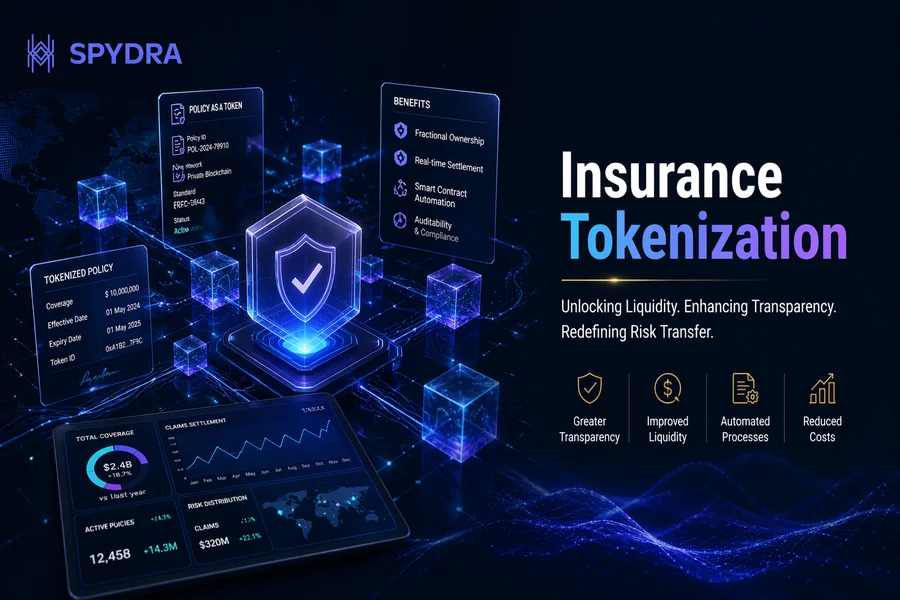
Introduction: The Insurance Industry’s Efficiency Problem
The global insurance industry—valued in trillions—still operates on legacy infrastructure. Claims processing is slow, fraud remains a challenge, and operational inefficiencies reduce profitability.
This is where insurance tokenization—powered by blockchain and enabled by a modern Web3 development company—is transforming the landscape. By digitizing policies and automating workflows, insurers can unlock speed, transparency, and entirely new business models.
This isn’t incremental innovation—it’s a foundational transformation.
What Is Insurance Tokenization?
Insurance tokenization is the process of converting insurance policies, risk pools, or coverage rights into digital tokens on a blockchain.
These tokens represent:
- Ownership of an insurance policy
- Participation in a risk pool
- Rights to future payouts or premiums
Simple Analogy:
Think of a traditional insurance policy as a static contract locked in a filing cabinet. Tokenization turns that contract into a programmable, tradable digital asset.
Instead of opaque agreements:
- Policies become transparent
- Claims become automated
- Risk becomes fractionalized and investable
How Insurance Tokenization Works
Insurance tokenization integrates blockchain infrastructure with insurance workflows. Here’s a simplified lifecycle:
1. Asset Identification
An insurance asset is defined:
- Policy (life, health, travel)
- Risk pool (crop insurance, catastrophe coverage)
- Reinsurance contract
2. Token Creation
The asset is digitized into blockchain-based tokens:
- Each token represents fractional ownership or exposure
- Tokens are secured and immutable
3. Smart Contract Integration
Rules are embedded into self-executing smart contracts:
- Premium payments
- Policy conditions
- Claim triggers
4. Distribution & Investment
Tokens can be:
- Sold to investors
- Allocated across stakeholders
- Integrated into digital marketplaces
5. Automated Claims Execution
When predefined conditions are met:
- Claims are triggered automatically
- Payments are executed instantly
- No manual processing required
Key Benefits of Insurance Tokenization
1. Transparency & Trust
Blockchain ensures all transactions are:
- Immutable
- Auditable
- Tamper-proof
This significantly reduces disputes and increases policyholder confidence.
2. Faster Claims Processing
Smart contracts eliminate manual workflows:
- Claims settle in minutes, not weeks
- Parametric triggers enable real-time payouts
3. Improved Liquidity
Traditionally illiquid insurance assets can now be:
- Fractionalized
- Traded
- Accessed by global investors
4. Fraud Reduction
Tokenization creates a single source of truth:
- Reduces duplicate claims
- Prevents data manipulation
5. Cost Efficiency
By removing intermediaries:
- Administrative costs drop
- Operational efficiency improves
6. Global Accessibility
Tokenized insurance opens access to:
- Cross-border investors
- Underserved populations (via microinsurance)
Top Use Cases of Insurance Tokenization
1. Parametric Insurance
Smart contracts enable automatic payouts based on external data.
Example:
- Flight delay → instant payout
- Rainfall threshold breached → crop insurance payout
No claims filing required.
2. Health Insurance Automation
Tokenization can streamline:
- Claims verification
- Hospital payments
- Policy tracking
Reducing friction across the healthcare ecosystem.
3. Life Insurance as Digital Assets
Policies can be:
- Tokenized and partially traded
- Used as collateral
- Integrated into wealth portfolios
4. Reinsurance & Risk Pool Tokenization
Large-scale risks can be:
- Distributed across investors
- Managed through decentralized pools
This improves capital efficiency for insurers.
5. Microinsurance for Emerging Markets
Tokenization enables:
- Low-cost, high-volume policies
- Mobile-first insurance distribution
- Financial inclusion at scale
Real-World Examples of Insurance Tokenization
While still emerging, several initiatives highlight the potential:
- Parametric crop insurance pilots using blockchain to automate farmer payouts
- Travel insurance platforms offering instant compensation for delays
- Reinsurance experiments where risk exposure is shared via tokenized pools
In many cases, insurers are partnering with blockchain platforms to test scalable models that reduce operational overhead while improving customer experience.
Challenges & Risks
Despite its promise, insurance tokenization faces several barriers:
1. Regulatory Uncertainty
- Jurisdiction-specific compliance requirements
- Classification of tokenized assets
2. Legacy System Integration
- Existing infrastructure is not blockchain-native
- Requires API and middleware layers
3. Market Education
- Stakeholders need to understand tokenization
- Trust must be built over time
4. Scalability & Adoption
- Enterprise-grade deployment requires robust platforms
- Interoperability remains a challenge
The Future of Insurance Tokenization
The convergence of blockchain, AI, and decentralized finance (DeFi) is accelerating innovation in insurance.
Key Trends:
- Decentralized insurance markets
- AI-driven underwriting + smart contracts
- Institutional adoption of tokenized risk assets
- On-chain insurance ecosystems
As infrastructure matures, tokenization will move from pilots to production at scale.
Why Spydra Is the Ideal Platform for Insurance Tokenization
To fully realize the benefits of insurance tokenization, enterprises need more than just blockchain—they need enterprise-grade infrastructure.
Spydra provides exactly that.
🔷 What Sets Spydra Apart:
- Compliance-Ready Architecture
Built for regulated industries like insurance and finance - Smart Contract Automation
Automate underwriting, claims, and payouts seamlessly - Scalable Tokenization Infrastructure
Designed for high-volume enterprise use cases - Interoperability & Integration
Easily connects with legacy systems and APIs - End-to-End Token Lifecycle Management
From issuance to governance and reporting
Final Thoughts
Insurance tokenization is not just a technological upgrade—it’s a paradigm shift.
By transforming policies into programmable digital assets, insurers can:
- Reduce costs
- Improve transparency
- Unlock new revenue streams
- Deliver superior customer experiences
The question is no longer if asset tokenization will reshape insurance—but how fast enterprises will adopt it.
Ready to Tokenize Your Insurance Products?
If you’re an insurer, reinsurer, or InsurTech innovator looking to lead this transformation:
Spydra empowers you to build, scale, and manage tokenized insurance solutions with confidence.
👉 Book a demo today and explore how Spydra can accelerate your tokenization journey.
