
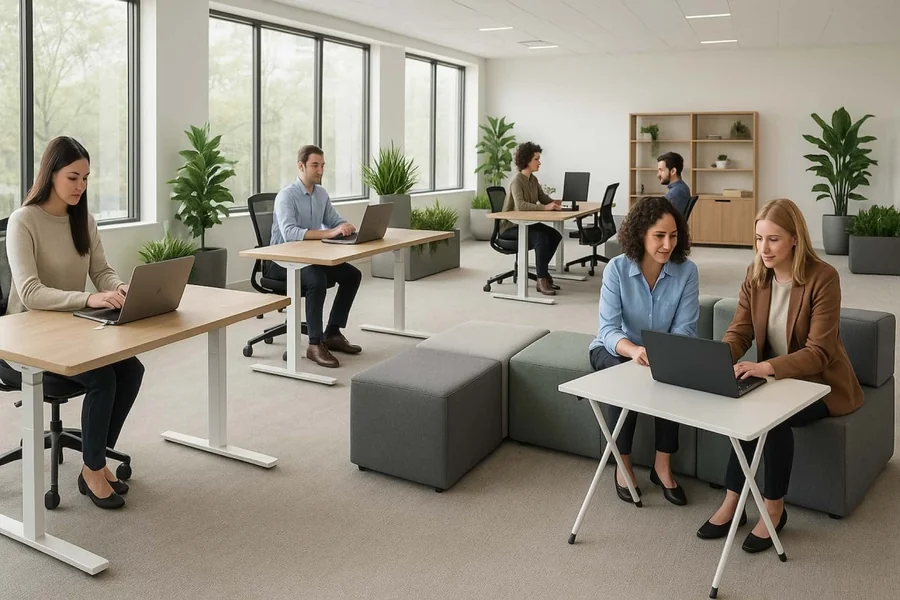
Buying office furniture used to be a simpler exercise. Companies counted desks, assigned seats, added meeting tables, and built the office around a workforce expected to be present every day. Hybrid work changed that logic. The office is no longer just a place where everyone sits; it is a place people use differently depending on the day, the task, and the reason they came in.
That shift has changed furniture strategy in a meaningful way. For property managers, facility teams, and business owners, the goal is no longer to furnish a fixed number of people in a fixed pattern. The goal is to support flexibility, shared use, collaboration, and occupancy swings without wasting floor space or overspending on furniture that sits idle too often.
Why Hybrid Work Changes Priorities
-
Flexibility Now Drives Furniture Decisions
In a hybrid environment, furniture choices must accommodate variable attendance rather than permanent occupancy. A business evaluating options such as ergonomic office furniture in Switzerland should no longer focus solely on the total number of people working for the company. The more relevant question is how many people will actually be in the office at the same time, what kind of work they will be doing when they arrive, and how easily the furniture can support changes in use from one day to the next. This changes the purchase strategy from static planning to adaptive planning.
-
The Office Must Serve Multiple Modes
Hybrid offices rarely support just one style of work. On some days, employees come in for meetings, collaboration, and project sessions. On other days, they need quiet space to concentrate on work between calls or visits. That means furniture can no longer be selected around a single workstation model. My full of fixed desks may look organized, but it may not support how the office is actually being used.
Purchase decisions now need to reflect multiple work modes. Shared desks, touchdown spaces, small collaborative tables, private focus areas, and flexible meeting furniture all become more important. The strategy shifts from buying as many individual desks as possible to building a workplace mix that reflects how hybrid teams actually operate.
-
Utilization Matters More Than Headcount
In traditional office planning, headcount often drove furniture budgets. In hybrid environments, utilization is a more useful metric. A company with one hundred employees does not necessarily need one hundred full workstation setups if only part of the team is present on a given day. At the same time, it may need more meeting and collaboration furniture than it once did, as these days they are often used for group activities rather than solo desk work.
This is one of the biggest strategy changes. Businesses should evaluate how often each type of furniture is used, not just how many employees exist in the organization chart. Furniture that supports actual office behavior creates more value than furniture purchased to match outdated attendance assumptions.
-
Shared Spaces Need Better Planning
Hybrid work increases pressure on shared-use furniture. When fewer employees have permanently assigned workstations, the office relies more heavily on shared desks, collaborative seating, reservable rooms, and multi-purpose areas. That means the quality and usability of these shared spaces matter more than ever.
A poor shared-desk setup quickly becomes frustrating if users cannot easily plug in items temporarily or work comfortably for several hours. Likewise, meeting areas need furniture that supports real collaboration rather than only formal conference use. In hybrid settings, shared spaces are no longer secondary. They often become the most important areas in the office, which means strategy has to treat them as such to create a great advantage.
Hybrid environments benefit from furniture that can move, adapt, and be reconfigured without major disruption. A fixed office layout may work well when use patterns are predictable, but hybrid schedules tend to create more variation. Some days call for open team sessions. Others require smaller group meetings or temporary quiet zones. Furniture that supports movement gives the office more ways to respond.
This is why mobile tables, lightweight seating, modular soft seating, and movable storage have become more valuable in hybrid planning. The goal is not constant rearrangement for its own sake. It allows shifting when needed without forcing the business into a costly redesign every time team behavior changes.
Buying for a hybrid means buying smarter.
Office Furniture purchasing strategies have changed work environments because the office itself has changed. It is no longer just a place for fixed daily occupancy. It is a flexible workspace that must support varying needs and different spaces throughout the week. That shifts purchasing away from simple desk counts and toward utilization, adaptability, comfort, and space efficiency.
For property managers, facility teams, and business owners, the practical lesson is clear. Hybrid offices need furniture that works harder, serves more than one purpose, and remains useful even as schedules and team patterns continue to evolve. The most effective strategy is not to buy unthinkingly but to buy more intentionally, with the real behavior of the workplace guiding every decision.
